Parents — not bureaucracies — decide what is right for their children. On Cape Cod and across Massachusetts, that principle is under quiet, deliberate assault: an ideology delivered to kids as young as five, and a state policy that tells schools to keep parents in the dark. Here is what’s happening — and how parents keep winning.
Parents have the first and final say in their children’s education and upbringing. We stand for transparent, age-appropriate curricula that parents can actually see, and against agendas set by agencies no voter can reach. That isn’t a culture-war slogan. It is the ordinary right of a mother and father to raise their own child — and it is exactly the right the system has decided it can work around.
The state tells your school: parents last.
This is not a rumor. Massachusetts’ own Department of Elementary and Secondary Education instructs school staff, in writing:
“School personnel should speak with the student first before discussing a student’s gender nonconformity or transgender status with the student’s parent or guardian.”
— Massachusetts DESE, gender-identity guidance
Read it again. The state that runs every Cape Cod district tells your child’s teachers to talk to your child — and defer to the child — before they talk to you. That is the official guidance. And it is exactly the framework that let a Massachusetts school do the unthinkable.
Ludlow: they hid a child’s transition from her own parents.
In Ludlow, Massachusetts, a middle-school child asked staff to use a new name and pronouns. The school began using them — and let the child choose which bathroom to use — while continuing to use the child’s birth name and pronouns in every communication with the parents. One identity at school; another one sent home. When the parents found out and sued, the courts sided with the school, and in April 2026 the U.S. Supreme Court declined to hear the case. This was not medical treatment. It was a public school deliberately concealing a child’s social transition from the people who love that child most. Under the same state guidance, it can happen in any Cape town.
Pronoun Day, gender lessons, and a five-year-old’s classroom.
The ideology arrives early, and dressed up as kindness. There is an annual “International Pronouns Day.” The activist group GLSEN writes pronoun and gender-identity lesson plans for K–12 classrooms — one elementary lesson teaches gender through “a class hamster named Hadhir who identifies as nonbinary.” In DeWitt, Michigan, a district rolled a gender-identity lesson into a first-grade class before parents forced them to cancel it. And when a Massachusetts seventh-grader wore a shirt reading “There are only two genders” — after his school held a Pride Day — the school ordered him to take it off. Pride Day for one message; censorship for the other.
But parents are winning.
Here is the hope, and it is real. When parents organize and go to court, they win:
- The U.S. Supreme Court, June 2025 — Mahmoud v. Taylor. A Maryland district forced LGBTQ storybooks on elementary kids and revoked every opt-out. The Court sided with the parents 6–3, rejecting the “it’s just exposure” excuse and noting the materials told teachers to reprimand children who disagreed.
- The Sixth Circuit, November 2025 — Olentangy. An Ohio district compelled students to use classmates’ preferred pronouns and barred “biological” ones. A federal appeals court ruled it likely violates the First Amendment.
- Lexington, Massachusetts, December 2025. A father denied the right to opt his kindergartner out of gender-identity material won a preliminary injunction.
The lesson is simple: none of this is inevitable. It is a choice — and organized parents keep beating it.
Close the library loophole.
Massachusetts law makes it a crime to hand a child obscene or “harmful to minors” material — but a carve-out in the statute (M.G.L. c. 272 §28) shields schools, libraries, and museums, and, as our neighbors on the Falmouth Republican committee put it, “material that would be unlawful to hand a child on the street can be placed on a school or library shelf.” They are pushing to close that loophole. We stand with them: if material is “harmful to minors” under Massachusetts law, that protection should not stop at the schoolhouse door.
Your own senator wrote the law that keeps it on the shelf.
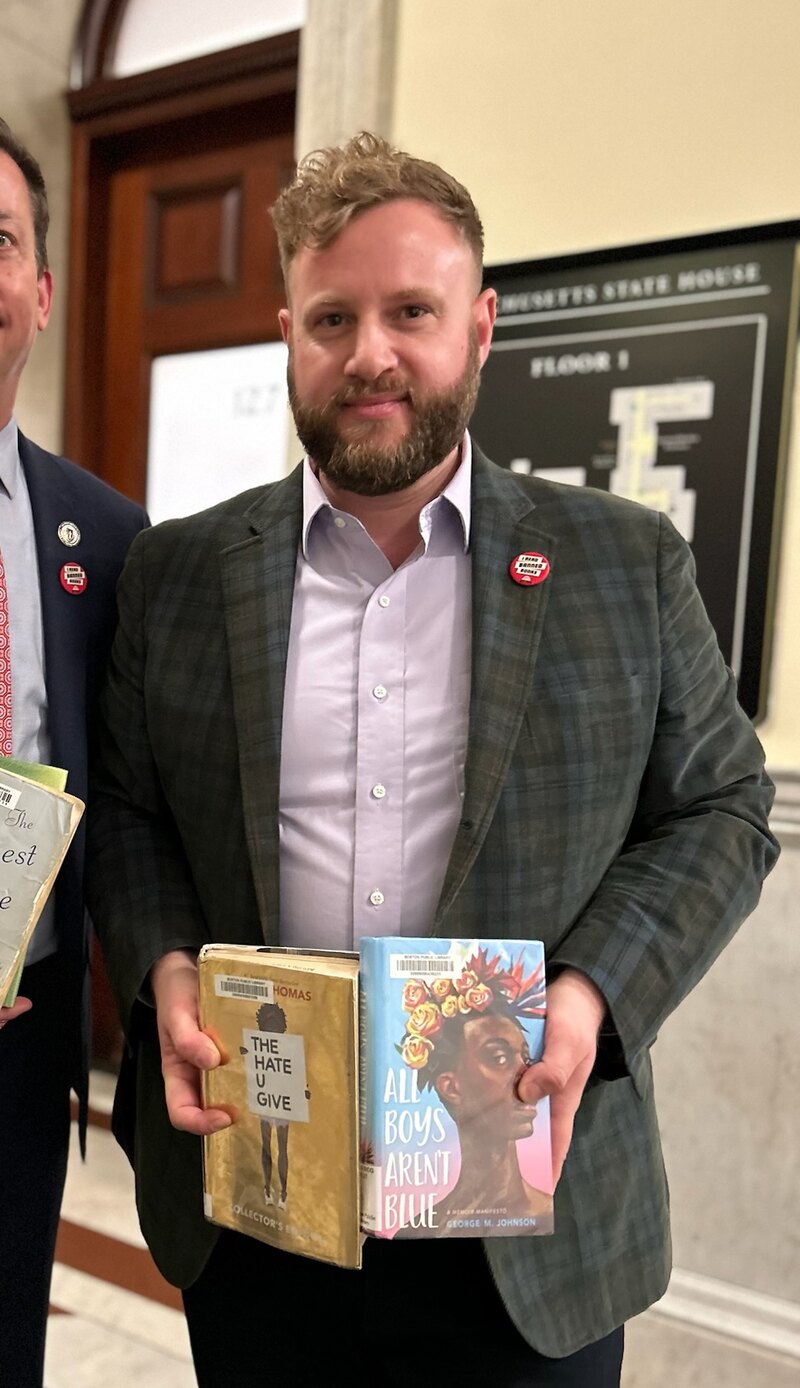
State Senator Julian Cyr — who represents Cape Cod — is the lead sponsor of Senate Bill S.2696, the bill that limits how and when a Massachusetts school or public library can remove a book, and keeps a challenged title on the shelf while it is reviewed. It passed the state Senate in November 2025. Cyr called it “decisive bipartisan action to push back against cowardly attempts to ban books.” Read the bill yourself »
So consider what he is defending. One of the books at the center of these fights is All Boys Aren’t Blue — a young-adult memoir that has been the single most-challenged book in America four years running, according to the American Library Association. It contains graphic, sexually explicit passages — including an explicit description of oral sex, and an account of the author being sexually abused by an older cousin at the age of thirteen.
The author needed a therapist to get over being sexually assaulted as a child — not a publisher to normalize it, and not a senator to keep it on our children’s shelves.
— a Cape Cod parent
We love great books, and we trust parents to raise their own children. Neither of those requires handing a graphic account of a child’s sexual abuse to a middle-schooler — then calling the parents who object “book-banners.”
Paying more, getting less.
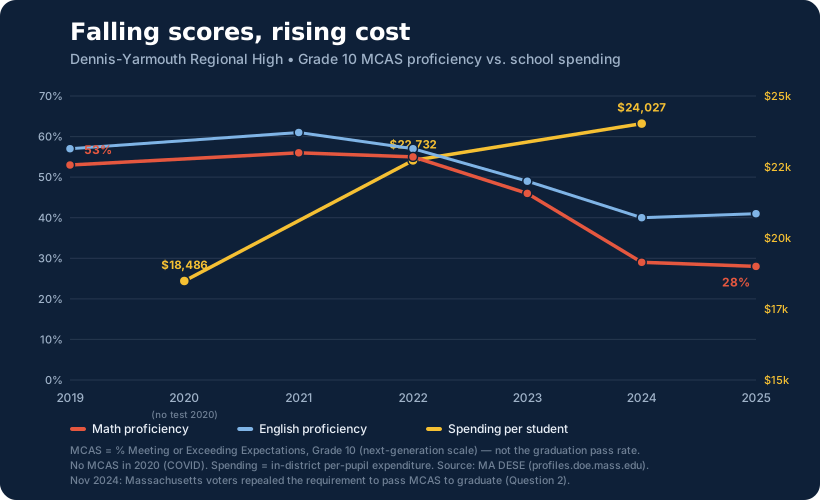
Here is the record for our own Dennis-Yarmouth Regional High School. Since 2019 the share of 10th graders meeting grade-level expectations on the state MCAS has fallen hard — math from 53% to 28%, English from 57% to 41% — while per-student spending climbed about 42%. Then, in November 2024, Massachusetts quietly removed the requirement that students pass the MCAS at all to graduate. Lower the bar, and the failing numbers stop being anyone’s problem.
The fight is already here in Dennis-Yarmouth.
This is not abstract. Right in our own Dennis-Yarmouth school district, neighbors organized as No DEI at DY after the district advanced a DEI hiring plan — a plan that, by their account, drew a federal civil-rights complaint. When a school system starts sorting staff and students by identity instead of judging everyone by merit and character, parents have every right to stand up and say no, out loud and on the record.
No DEI at DY · Dennis-Yarmouth
Concerned Citizens of Dennis-Yarmouth — standing against the district’s DEI hiring plan and the agenda that follows it.
Where we stand
- Parents first — always notified. No school should hide a child’s social transition, or anything else that matters, from that child’s own parents.
- Transparency. Parents have the right to see what is taught and what is on the library shelf.
- A real opt-out from ideological material — a right the courts keep affirming.
- Age-appropriate classrooms focused on reading, math, history, and the skills kids actually need.
- Accountability to parents and voters — not to distant bureaucracies.
Sources: Massachusetts DESE gender-identity guidance (doe.mass.edu — quoted verbatim); Foote v. Ludlow (1st Cir. 2025; cert. denied 2026); Mahmoud v. Taylor, 606 U.S. 522 (2025); Olentangy pronoun ruling (6th Cir., Nov. 2025); Lexington opt-out injunction (Dec. 2025); GLSEN pronoun lesson materials; Middleborough “two genders” shirt case (1st Cir. 2024); Massachusetts S.2696 & Sen. Cyr statement (malegislature.gov; Senate passage Nov. 13, 2025); American Library Association most-challenged-books lists and the challenge record for All Boys Aren’t Blue; M.G.L. c. 272 §28 (Falmouth RTC). Court outcomes stated as decided; advocacy-group materials attributed as such.